
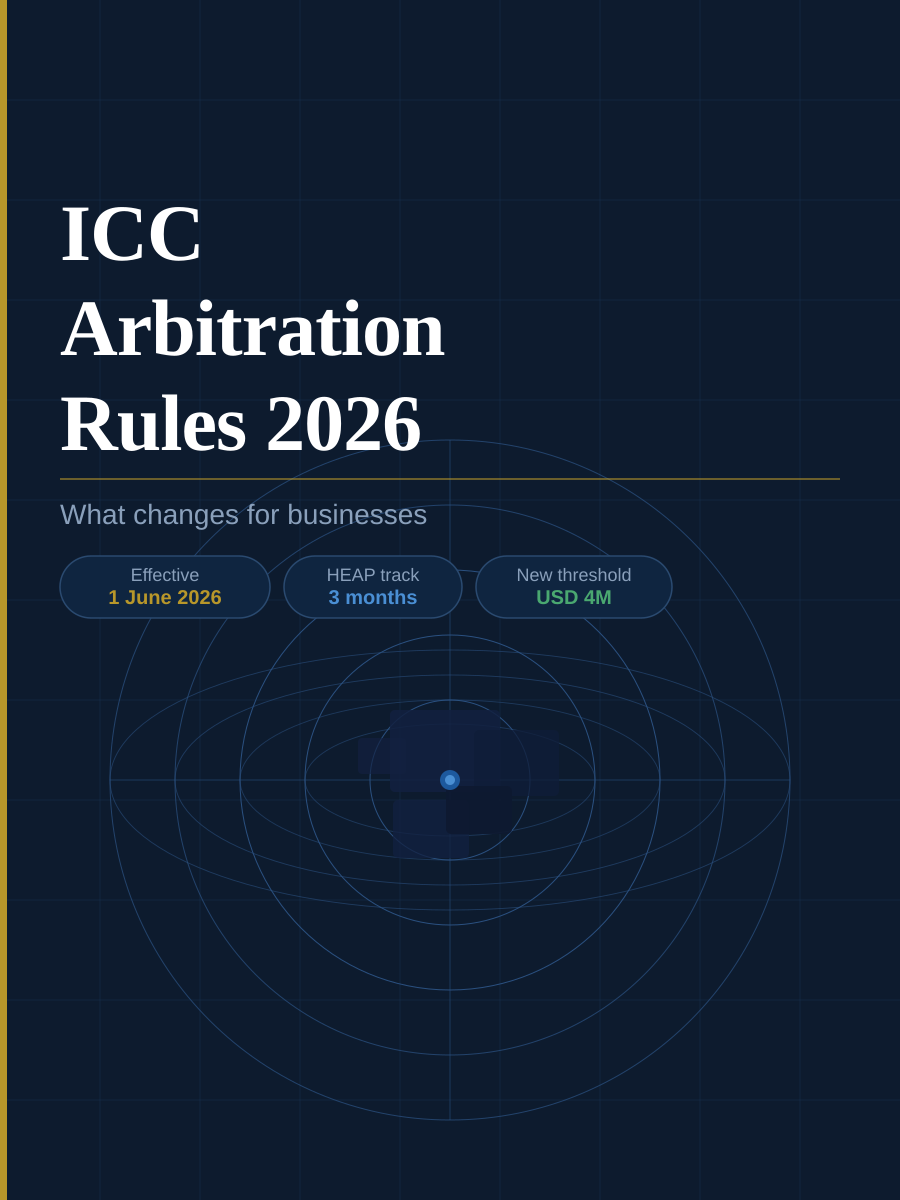
Terms of Reference are no longer mandatory. The first case management conference (CMC) — held within 30 days of the tribunal receiving the filing — now marks the last opportunity to introduce new claims without tribunal authorisation. Under the 2021 Rules, the deadline was the signing of the Terms of Reference or their approval by the Court. This shifts the strategic focus: parties need to be ready earlier, and the opening stage of proceedings becomes more consequential than before.
A new Highly Expedited Arbitration Procedure (HEAP) is now available on an opt-in basis, with a final award due within three months of the initial CMC. One arbitrator, no hearing — documents only. HEAP may be a meaningful option for straightforward commercial disputes where speed matters more than procedural breadth.
The threshold for automatic application of the Expedited Procedure has been raised from USD 3M to USD 4M — reflecting the rising value of disputes and the growing confidence in streamlined ICC proceedings.
Early determination of manifestly unmeritorious claims is now explicitly provided for. Preliminary orders from emergency arbitrators may be sought without prior notice to the opposing party. Written communications default to electronic. Awards may be signed electronically or in counterparts.
The 2026 Rules push ICC arbitration toward front-loaded preparation and faster resolution. For counsel, this means that strategy must be sharper from day one — the procedural latitude that existed under the 2021 Rules has narrowed.
This is particularly relevant for construction and energy disputes, where complex, multi-tier claim structures and tight project timelines make front-loaded preparation and expedited tracks commercially critical.
For businesses, particularly multi-jurisdictional and parties facing CIS-related disputes, the revisions are relevant in two ways. First, the new highly expedited track offers a credible path for resolving disputes where prolonged proceedings are commercially unacceptable. Second, the removal of Terms of Reference as a default step — combined with tighter control over new claims — means that the quality of the initial Request and the first CMC will increasingly determine the entire trajectory of the case.
ICC arbitration remains one of the few internationally recognised forums accessible for disputes involving CIS parties or assets, subject to sanctions compliance. The 2026 Rules do not change this — but they do make ICC proceedings more efficient and more predictable. In a sanctions environment where enforcement windows and opponents' positions shift, efficiency and procedural discipline matter more than ever.
The revision aligns ICC arbitration with existing expectations of sophisticated parties. For those drafting new arbitration clauses or managing live disputes, familiarity with the 2026 Rules is not optional — it is part of sound dispute risk management.
The full 2026 Rules and a comparison against the 2021 version are available here.
Resolut advises on international arbitration proceedings under ICC, LCIA, SCC, DIAC and other institutional rules, including disputes with CIS-nexus elements.